
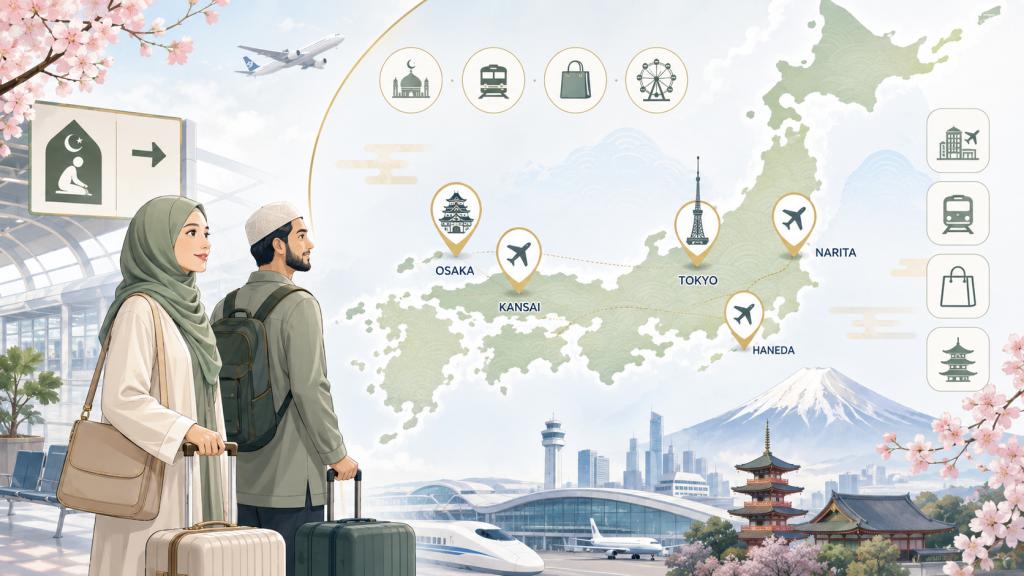
“Will I actually be able to pray properly in Japan?”
If you’re a Muslim planning a trip to Japan, this is probably one of the very first worries to cross your mind. With mosques still relatively few and far between, how do you keep up your five daily prayers (salah)? It’s a completely natural thing to wonder about.
Here’s the good news: you can relax. Over the past few years, prayer rooms in Japan have multiplied — appearing in airports, train stations, shopping malls and major tourist spots. Once you know where to look, you can stop watching the clock and simply enjoy your trip. Think of this article as your map to the most useful prayer spaces in the country.
Three Things Worth Knowing First
1. As a traveller, you’re allowed to combine your prayers
In Islam, a traveller (musafir) may combine Dhuhr with Asr, and Maghrib with Isha. So even on a jam-packed sightseeing day, staying on top of your prayers is far easier than you might fear.
2. No prayer room? A clean, quiet spot will do
Keep a lightweight prayer mat in your bag and you can pray almost anywhere clean and calm — a quiet corner of an airport lounge, your hotel room, a peaceful park. A dedicated prayer room is a lovely comfort, not a strict requirement.
3. What to look for in a Japanese prayer room
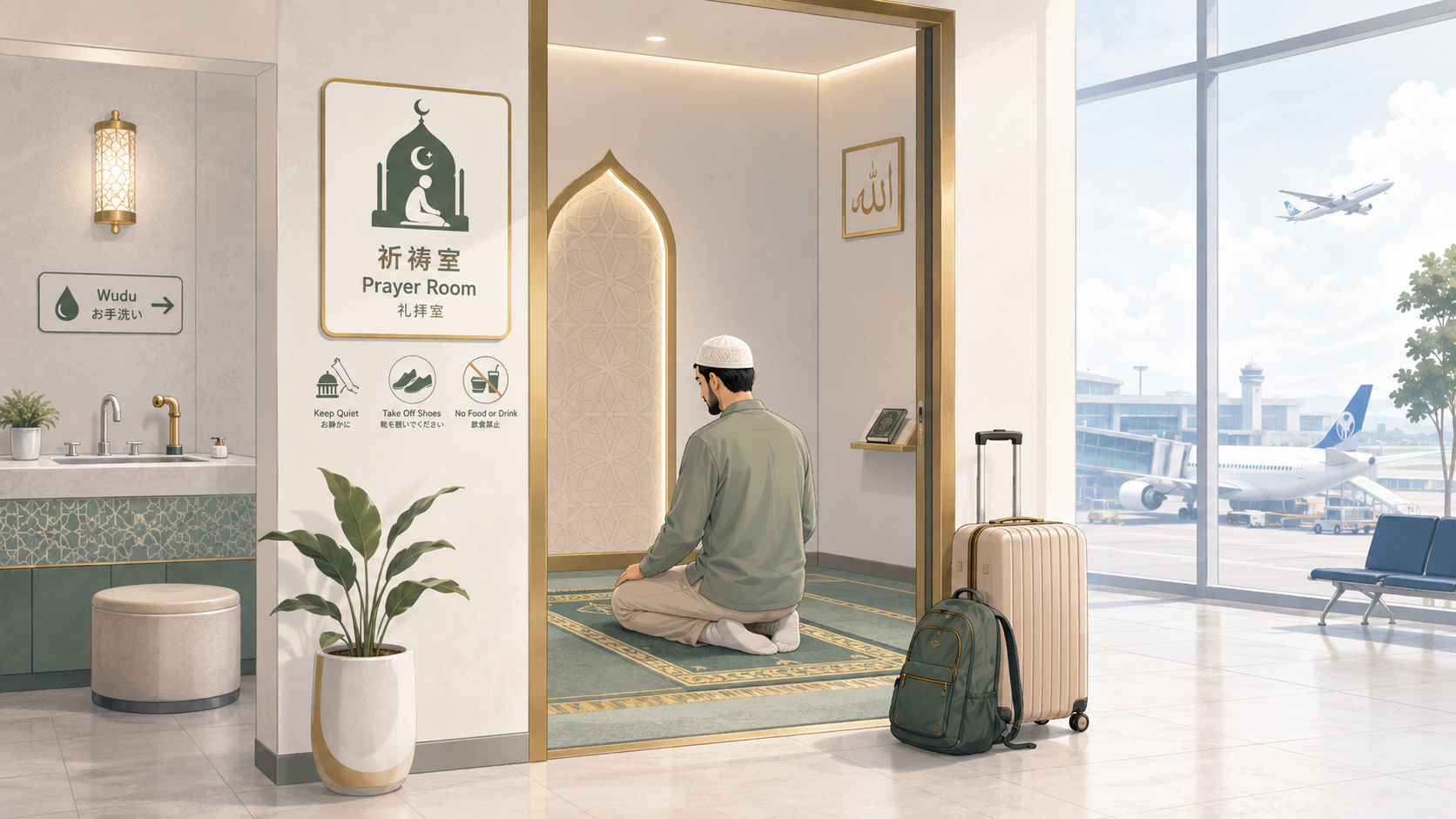
When you step into one, keep an eye out for these three things:
- Wudu facilities — a water area for ablution before prayer. A real bonus when it’s there.
- Qibla marker — a sign pointing toward Makkah, often on the ceiling, a wall, or woven into the carpet pattern.
- Gender separation — some rooms are divided by partitions or curtains; others offer entirely separate male and female rooms.

▲ A typical, well-equipped prayer room in Japan
✈️ Prayer Rooms at the Airport
Arrival and departure almost always land right on a prayer time — and thankfully, Japan’s major airports have you covered.
Narita International Airport (NRT)
All three terminals — 1, 2 and 3 — have prayer rooms, located both before and after security. Each comes with wudu facilities, and a marker on the ceiling points the way to Makkah, with partitions separating men and women. Even Terminal 3, the budget-airline hub, has one — so flying low-cost doesn’t mean missing out.
Haneda Airport (HND)
You’ll find prayer rooms in Terminal 3’s departure lobby, and in Terminal 2’s international departure lobby and post-immigration area — each fitted with facilities to purify yourself before prayer. There are also fully equipped prayer rooms, complete with wudu and a qibla marker, at Haneda Airport Garden (connected directly to Terminal 3) and the Haneda Innovation City complex — handy if you have time to spare around the airport.
Kansai International Airport (KIX)
Prayer rooms sit in the general area on the 3rd floor of Terminal 1 (north side) and in the international departure gate area (near Gate 16). All are split into separate male and female rooms with wudu facilities — and best of all, they’re open 24 hours, so even a red-eye flight is no problem at all.
🗼 Prayer Rooms at Tourist Spots & Towers
Even at the highlights of your trip, there’s a place set aside for you to pray.

Tokyo Skytree®
On the 1st floor you’ll find separate prayer spaces for men and women, each with prayer mats laid out and a qibla marker on the ceiling. At the entrance you can sanitise your hands and wash your feet, and slippers are free to borrow. It’s open throughout Skytree’s operating hours — so after taking in the view of Tokyo from high above, you can pray with complete peace of mind.
Tokyo Midtown (Roppongi)
A buzzing Roppongi hub where shopping and sightseeing meet. The prayer rooms are split between the 1st floor (women) and the 3rd floor (men). During Galleria opening hours, they’re free to use with no booking required.
Azabudai Hills
There’s a prayer room on the 4th floor of Tower Plaza. Press the intercom to unlock the door; a wudu space is attached, with room for three to four people to pray at once.
🚉 Prayer Rooms at Stations & Shopping Spots
Between sightseeing and a spot of shopping, prayer rooms are dotted right across the city.
Tokyo Station
Tucked inside “Ekitabi Concierge Tokyo” (the JR EAST Travel Service Center) by the Marunouchi North Exit. It’s a quiet space for about two people, with wudu facilities included. It’s usually kept locked, so press the intercom and a staff member will let you in. Open to people of every faith and denomination.
Seibu Shibuya
The prayer space is on the 1st floor, with the wudu area one level down on B1. The men’s and women’s spaces sit side by side, divided by a curtain — and there’s a bonus women-only prayer space close by.
Toyosu Senkyakubanrai
This lively complex right beside Toyosu Market has a prayer room on the 2nd floor, complete with wudu, hot water and a qibla marker. Just the thing after a fresh seafood feast.
A Few More Handy Spots
- Tokyo Dome — a prayer room inside the lost-and-found office on the R floor (behind the police box). Wudu is available; just ask a staff member.
- Grandberry Park (Minami-Machida) — a prayer room with separate male and female areas plus a shared wudu space.
- Ariake Garden — a prayer space with wudu and a qibla marker.
Look beyond Tokyo and you’ll find prayer rooms in AEON Malls too (Makuhari Shintoshin, Narita, Nagoya Chaya, Tokoname, Okinawa, Hiroshima and more) — so even while shopping in smaller cities, you’re rarely far from a place to pray.
🕌 When You’d Rather Have a Mosque

For an unhurried prayer — or for the Friday Jumu’ah prayer — nothing beats a proper mosque (masjid). In Tokyo, Tokyo Camii (Yoyogi-Uehara) is celebrated as one of Japan’s largest and most beautiful mosques. Beyond prayer, its magnificent Ottoman-style architecture draws sightseers of every background, making it a perfect stop that blends worship with a little tourism.
Elsewhere across the city you’ll come across Kinshicho Mosque, Akabane Mosque, Shin-Koiwa Masjid and others, scattered throughout the neighbourhoods.
What to Do When There’s No Prayer Room
Not every place has a prayer room. When that happens —
- Keep a foldable prayer mat in your bag.
- Choose somewhere clean and calm — your hotel room, a department-store rest area, a quiet park.
- Perform wudu in an accessible restroom or washbasin (just be mindful of the people around you).
- On travel-heavy days, consider combining your prayers.
Japanese people are often unfamiliar with other faiths’ customs, but they very rarely react with any hostility toward prayer. Find a calm spot and you’ll be able to pray without trouble.
Handy Apps & Tools 📱
Worth installing before you fly:
- Halal Gourmet Japan / Halal Navi — find nearby prayer spaces and halal restaurants.
- Masjid Finder — search mosques across Japan on a map.
- Muslim Pro and similar — prayer-time alerts and a qibla compass (in Japan, aim roughly west-northwest).
Final Thoughts
Japan once had a reputation as a country where finding a place to pray was a real struggle. Today, with prayer rooms spreading across airports, stations, malls and tourist spots, life has become so much easier for Muslim travellers.
Check where the prayer rooms are ahead of time, slip a prayer mat into your bag, and you can enjoy Japan without a single worry about your salah. So relax — and savour the cherry blossoms, the food and the views to your heart’s content.
Safe travels! 🌸
