
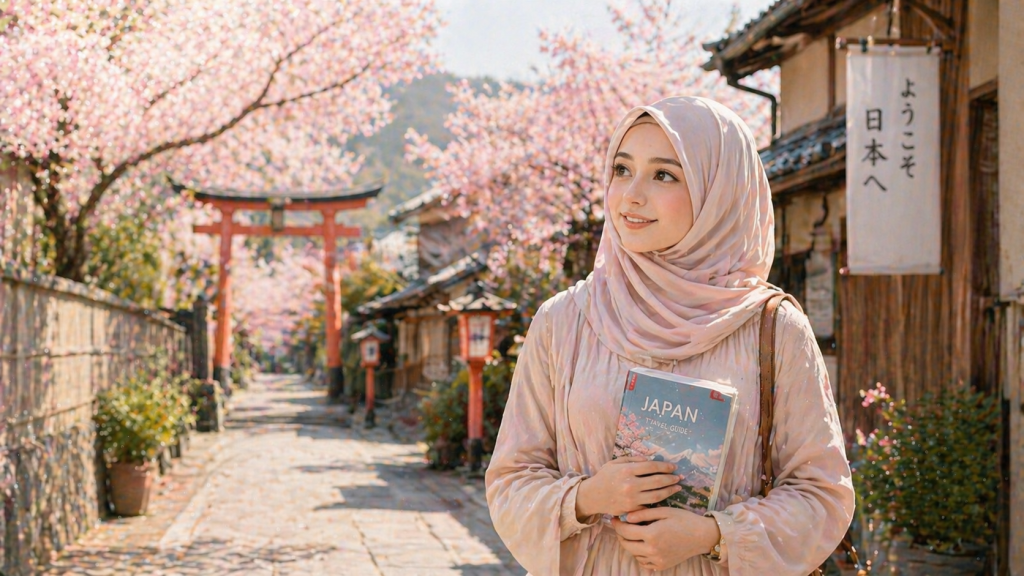
“What if I accidentally offend someone?”
“Is Japanese etiquette really that strict?”
“Will people stare if I pray or ask about food?”
Heading to Japan soon? You’re not alone — these worries pop up for everyone 💫
Good news: you don’t need to be perfect.
A few simple basics go a long way. This guide breaks down Japan’s everyday manners — written for Muslim travelers, kept short and clear ✨
1. The Big Picture 🇯🇵
First trip to Japan? You might wonder:
- “Is this rude?”
- “What should I avoid?”
- “How do I blend in?”
Relax. Japanese people are kind to visitors. Small mistakes rarely become big problems.
But a few basics? They’ll make your trip smoother 🍀
2. Quiet & Aware — That’s the Japan Vibe 🤝

The first thing you’ll notice: everything feels calm.
What “fitting in” looks like
- Speak softly on trains 🚆
- Line up — always
- Watch the flow in crowds
- Stay calm at shops
It’s less about rules. More about not making others uncomfortable.
Be a bit quieter. A bit more aware. You’ll fit right in 🌿
💡 Magic word: “Sumimasen” — it means sorry, excuse me, AND thank you. Use it everywhere.
3. Shops & Public Spaces 🍽️
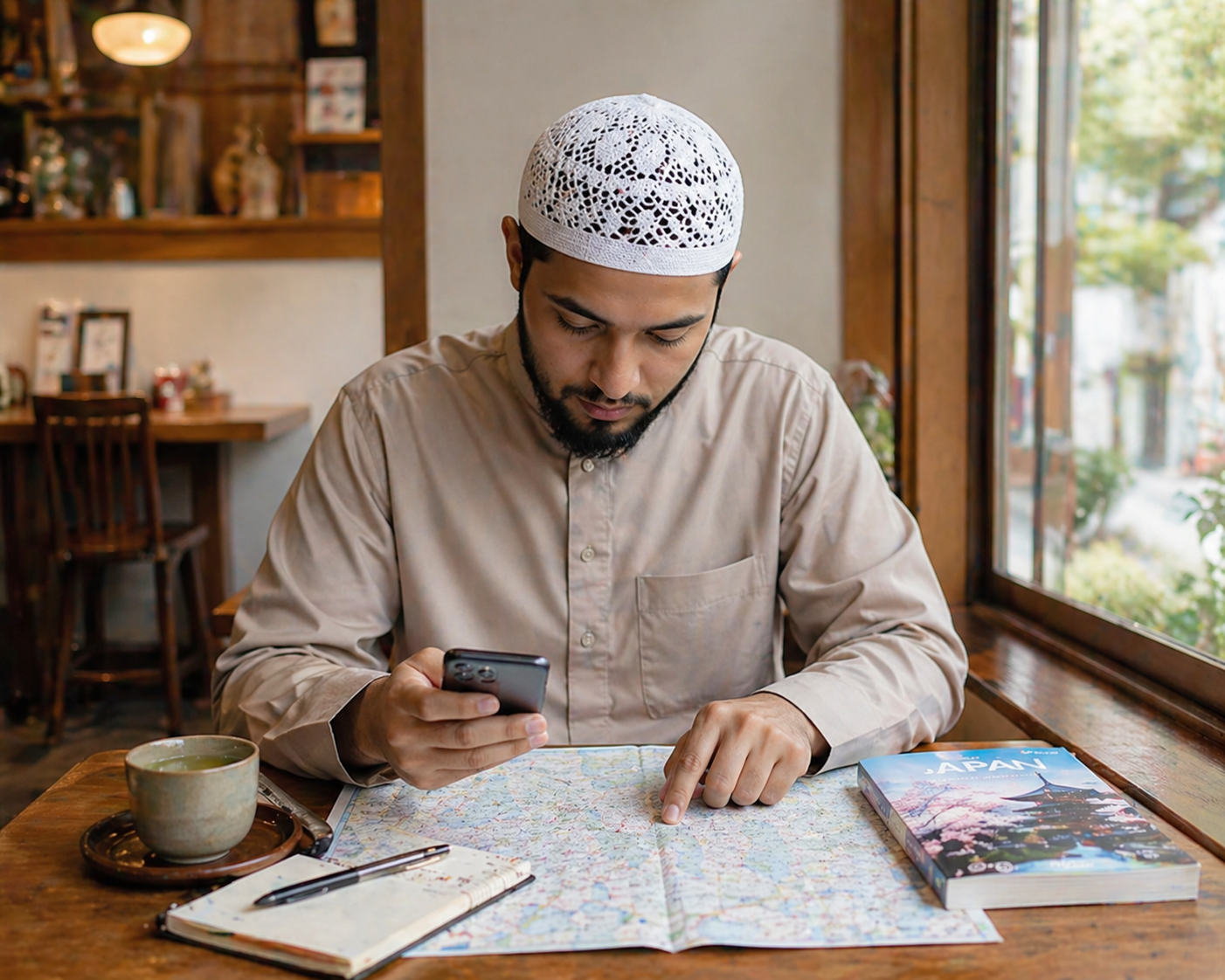
A few quick rules that work almost everywhere:
Lines form everywhere. Look for floor markings at convenience stores — they show where to stand.
A smile and small nod work. “Thank you” alone is fine.
OK in Asakusa or Arashiyama. Avoid in Ginza or quiet streets. Eat near the shop you bought from.
You’ll find them at stations and convenience stores. Carry a small bag — you’ll need it 👜
No phone calls. Keep your voice low. Silent mode near priority seats.
Quick Cheat Sheet
✅ Do
- Line up
- Say “Sumimasen”
- Small bow
- Photos where allowed
- Walk quietly
⚠️ Avoid
- Phone calls on trains
- Loud talking
- Eating in quiet streets
- Photos in no-photo zones
- Cutting in line
4. Politeness Beats Perfect Japanese 💬

Can’t speak Japanese? No problem.
Attitude > grammar. These work just fine:
- “Thank you”
- “Excuse me”
- “Please”
- A small bow
- A calm smile
5 Phrases Worth Saving
- “Sumimasen” — sorry / excuse me / thank you (all-in-one)
- “Arigatou gozaimasu” — polite thank you
- “Kore wa nan desu ka?” — what is this?
- “Butaniku haitte imasu ka?” — does this have pork? 🕌
- “Osake haitte imasu ka?” — does this have alcohol?
Lost in translation? Just show a map. Or use Google Translate 📱
You’ll be surprised how much works out without words.
5. Smart Prep for Muslim Travelers 🕌

A few extras worth thinking about before you go:
Searching on the go gets tiring. Apps like Halal Gourmet Japan and Halal Navi save the day.
Save mosques and prayer rooms on your map. Tokyo Camii, Masjid Kyoto, Osaka Masjid are the big ones.
One area per half-day works best. Tokyo example: Ginza/Tsukiji → Asakusa → Shinjuku → Shibuya.
Save halal-friendly spots on Google Maps. Less stress, more fun.
6. FAQ: Quick Answers 💬
Q. Can’t find a prayer spot?
A. Try department stores or airports — many have multi-purpose rooms. Halal Navi app helps. Your hotel room works too 🕌
Q. How do I check for alcohol or pork in food?
A. Just ask: “Does this contain alcohol or pork?” Save it as a phone note. Easy.
Q. Can Muslims visit shrines and temples?
A. Yes — as a tourist, it’s totally fine. Just stay quiet and skip the prayer rituals if you’d rather not.
Q. Onsen (hot springs) with hijab?
A. Public onsen is tricky. But many places now offer private baths — ask for “kashikiri-buro” when booking.
Q. Is English widely spoken?
A. In tourist areas, yes. Outside? Google Translate + a smile goes a long way 📱
7. The 5 Things to Remember ✅
- Quiet on trains 🚆
- Short and polite at shops
- Calm at shrines and temples ⛩️
- Follow the flow in crowds
- Pre-pick meal options 🍽️
A little awareness goes a long way 🌸
8. Final Thoughts 🌸
Japanese manners might sound complicated. They’re not.
Just four things:
- Stay quiet
- Be aware
- Stay polite
- Respect religious sites
That’s it. You’ll fit in naturally.
A new culture can feel a bit nervy. But a little prep changes everything. Have an amazing trip 🌍
Helpful? Share it with fellow travelers 💌
Related Articles 📚
